

Container orchestration tools are platforms that manage containerized applications across multiple servers. This means they handle tasks like starting containers, moving them between servers when needed, and making sure your applications stay running even if something breaks.
These tools become essential when you’re running more than a few containers. Without orchestration, you’d need to manually start each container, monitor if it crashes, and figure out how to distribute traffic between them. That quickly becomes impossible as your applications grow.
Below are Top 10 Container Orchestration Tools (Kubernetes Alternatives):
- Docker Swarm
- Apache Mesos
- Nomad (by HashiCorp)
- Amazon ECS (Elastic Container Service)
- Azure Container Instances (ACI)
- Google Cloud Run
- Rancher (Standalone Orchestration Mode)
- OpenShift (Non-Kubernetes Workflows)
- HashiCorp Waypoint
- Platform9 Managed Services
1. Docker Swarm
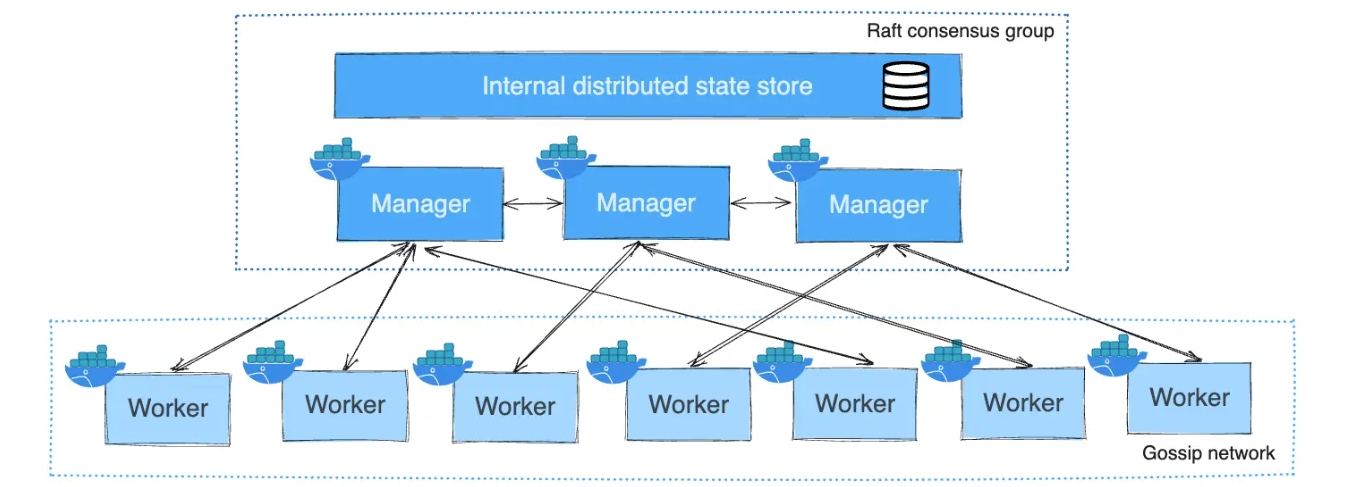
Docker Swarm is the orchestration solution that comes bundled with the Docker container platform. It lets you create a cluster of Docker hosts and then distribute containers across them.
It supports declarative configuration, rolling updates, and automatic service discovery. Its simple developer experience is similar to working with regular Docker containers, making it accessible to dev teams already using Docker for local work.
Docker Swarm is a good option for teams that want to quickly achieve high availability for smaller projects. It’s easy to outgrow at scale because it has limited observability and governance features. It also lacks direct integrations with cloud platforms, so you must configure your infrastructure yourself.
2. Apache Mesos
Mesos is a cluster management tool developed by Apache that can efficiently perform container orchestration.
The Mesos framework is open-source, and can easily provide resource sharing and allocation across distributed frameworks. It enables resource allocation using modern kernel features, such as Zones in Solaris and CGroups in Linux.
Moreover, Mesos uses Chronos Scheduler to start and stop services, and the Marathon API to scale services and balance loads. To let developers define inter-framework policies, Mesos uses a pluggable application module.
3. Nomad (by HashiCorp)
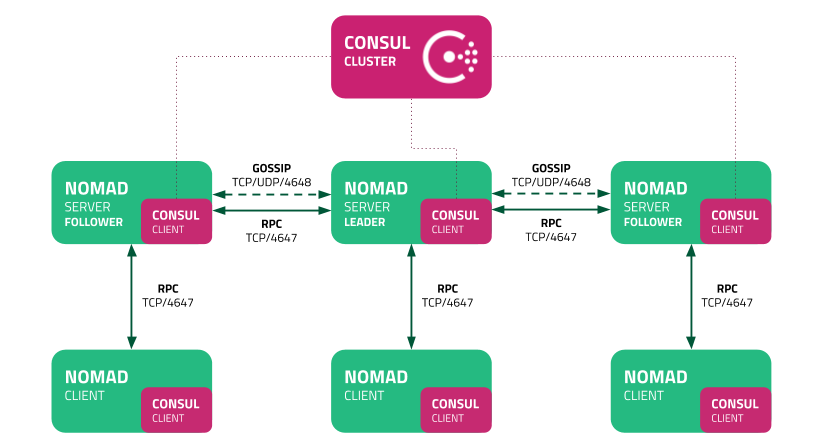
Nomad is a flexible workload orchestrator that enables an organization to easily deploy and manage any containerized or legacy application using a single, unified workflow. Nomad can run a diverse workload of Docker, non-containerized, microservice, and batch applications.
It enables developers to use declarative infrastructure-as-code for deploying applications. Nomad uses bin packing to efficiently schedule jobs and optimize for resource utilization. Nomad is supported on macOS, Windows, and Linux.
Nomad is widely adopted and used in production by PagerDuty, Target, Citadel, Trivago, SAP, Pandora, Roblox, eBay, Deluxe Entertainment, and more.
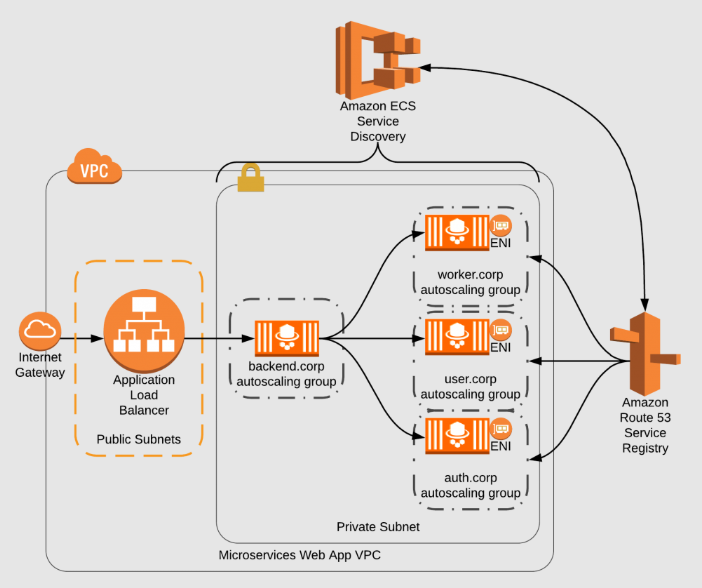
4. Amazon ECS (Elastic Container Service)
Amazon ECS is a fully managed container orchestration service that enables teams to build, manage, and run even the most demanding containerized workloads without the complexity of infrastructure management, freeing up development teams to innovate faster.
Amazon ECS empowers you to leverage AWS best practices to drive well-architected outcomes of availability, reliability, and performance while strengthening security through application isolation, IAM roles, automated patching, encrypted ephemeral storage, and native AWS security integrations.
With pay-as-you-go pricing, efficient resource utilization and offloading operational tasks, Amazon ECS reduces total cost of ownership so development teams can focus on delivering business value.
5. Azure Container Instances (ACI)
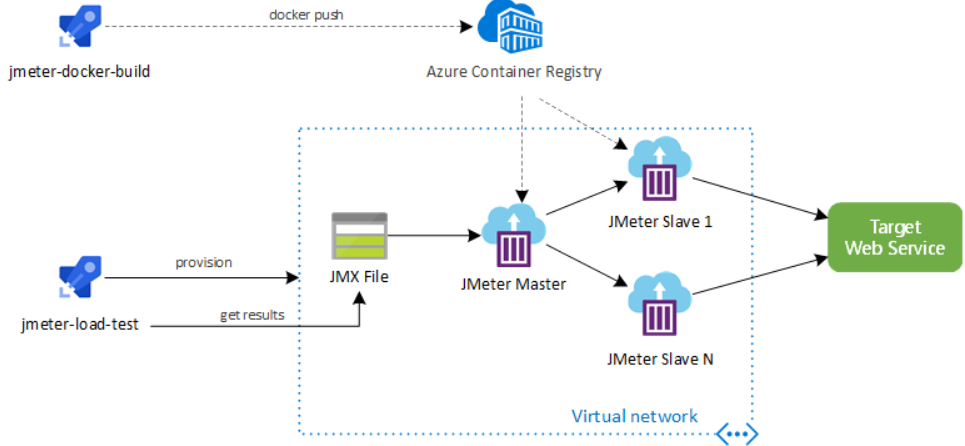
Azure Container Instances (ACI) is Microsoft PaaS (Platform as service) solution that offers the fastest and simplest way to run a container in Azure, without having to manage any underlying infrastructure.
For container orchestration in Azure (build, manage, and deploy multiple containers) use Azure Kubernetes Service (AKS).
You can deploy Azure Container Instances using Azure Portal, Azure CLI, Powershell, or ARM Template. Same as the docker registry we can push our images to Azure Container Registry (ACR) which is a private secure registry propose by the Azure platform.
6. Google Cloud Run
Google Cloud Run is a service managed by Google, with which containers can be provided, which can be called via HTTP requests, for example. The platform enables developers to create and run applications in the cloud without having to worry about the infrastructure on which they run.
With Cloud Run, microservices can be easily provisioned and scale quickly on demand. Enterprises can also combine Cloud Run with other Google Cloud services such as Cloud Storage, Cloud SQL and Stackdriver to build more complex applications.
In doing so, the technology is suitable for building and deploying web applications, APIs and microservices that require high availability and scalability, and supports a wide range of programming languages and frameworks (e.g. Go, Node.js, Python, Java, .NET Core or Ruby).

7. Rancher (Standalone Orchestration Mode)
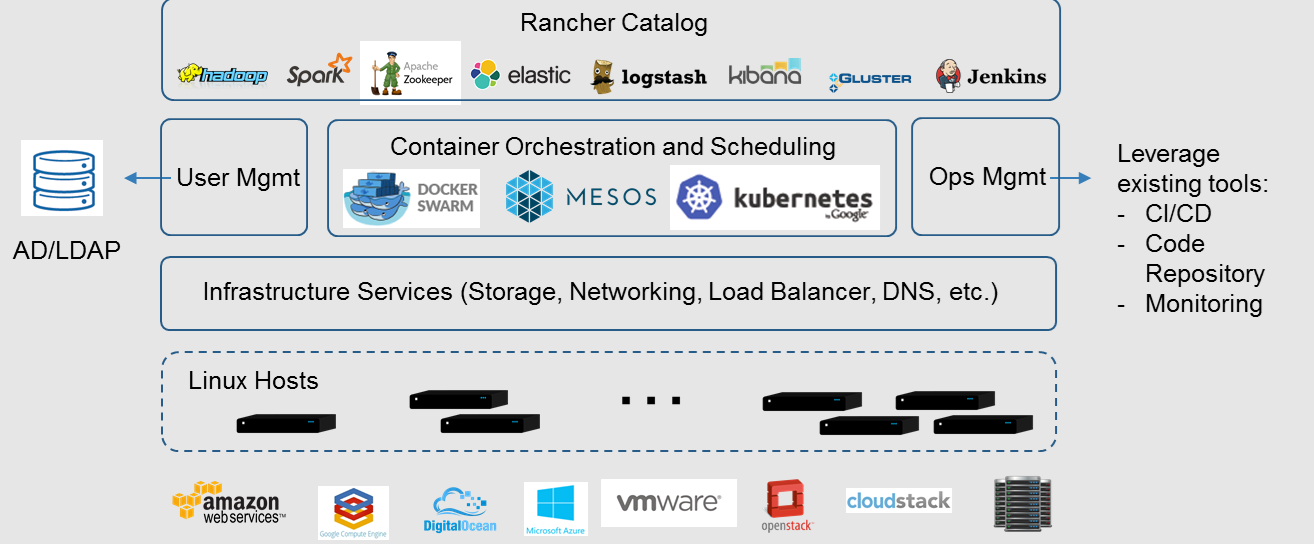
Rancher is a Kubernetes management platform that simplifies running multiple clusters across different environments. It provides a unified interface for managing clusters whether they’re on-premises, in the cloud, or at the edge.
The platform handles provisioning, upgrades, and backup/restore operations for Kubernetes clusters on any infrastructure.
The platform centralizes security functions like authentication, RBAC policy management, and audit logging across all your clusters.
It integrates with enterprise authentication systems like LDAP, Active Directory, and SAML, while providing global security policies that cascade to all managed clusters. Its centralized monitoring and alerting capabilities give security teams visibility across the entire container environment, with CIS benchmark scanning to identify misconfigurations.
8. OpenShift (Non-Kubernetes Workflows)
OpenShift was developed by Red Hat to provide a hybrid, enterprise-grade platform that extends Kubernetes functionalities to companies that require managed orchestration.
The framework is built on an enterprise-grade Linux Operating System that lets you automate the lifecycle of your containerized application. This lets you easily manage all your workloads using a container to virtualize every host. More so, with its various templates and prebuilt images, OpenShift lets you create databases, frameworks, and other application services easily.
As a result, you get a highly optimized platform that standardizes production workflows, enables continuous integration, and helps companies automate the management of releases.
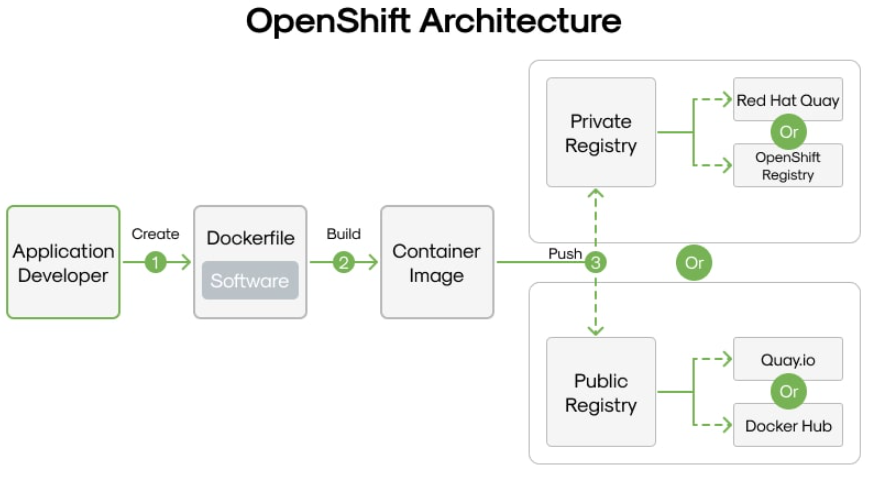
OpenShift offers both Platform-as-a-Service (PaaS) and Container-as-a-Service (CaaS) cloud service computing models. This essentially lets you either define your application source code in a Dockerfile or convert your source code to a container using a Source-to-Image builder.
9. HashiCorp Waypoint
HCP Waypoint is an internal developer platform (IDP) that allows platform teams to define golden patterns and workflows that enable a self-service experience for developers.
HCP Waypoint helps app developers who are responsible for creating applications and the platform engineers responsible for maintaining the infrastructure the applications run on.
These roles may overlap or align differently in your organization, but HCP Waypoint is intended to ease the workload for any practitioner responsible for either set of tasks.
10. Platform9 Managed Services
Platform9 is a SaaS-managed hybrid cloud and container management solution designed for data centers and public clouds.
It enables users to plug in various environments to the SaaS-managed control plane, modernize applications with enterprise-grade Kubernetes, manage VMs via OpenStack hybrid clouds to support a broad range of applications, as well as accelerate application development across any environment.
Features include self-service provisioning, automatic provisioning, push-button deployment, built-in monitoring and alerts, multi-cluster management, and identity and access management.
Conclusion
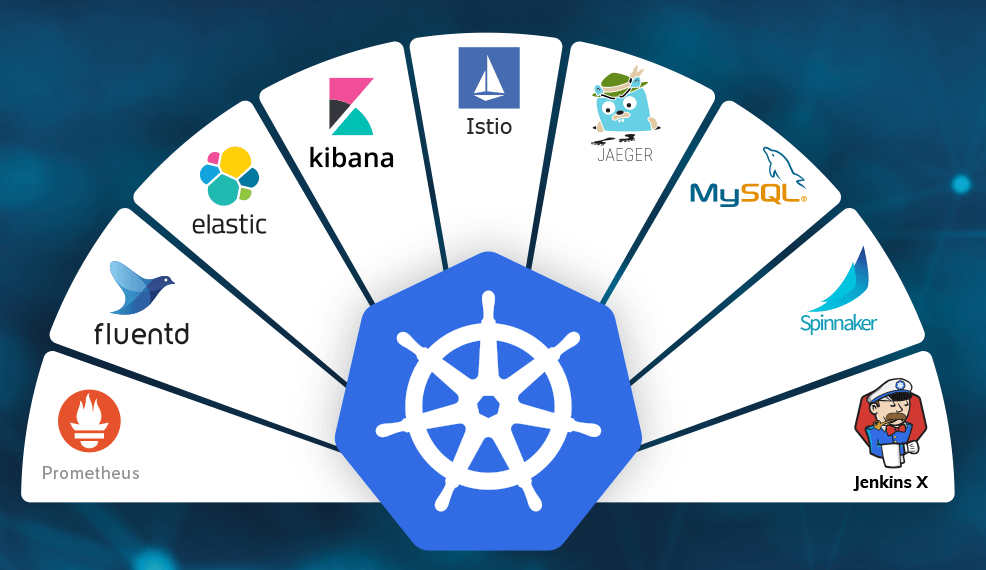
Leading container orchestration platforms—such as K8s (Kubernetes), Docker Swarm, and similar solutions offer essential capabilities like auto-scaling, traffic load balancing, and multi-cloud compatibility.
These platforms are built to support a wide range of organizational use cases and infrastructure setups.



Pingback: Top 6 Load Testing Tools for Scalable Apps – TopatTop.com
Pingback: Top 7 Kubernetes Alternatives for Cloud-Native Scaling (2026 Edition) – TopatTop.com